
News & InsightsPanelist Spotlight
The Case for Preserving Motion: Dr. Brian McHugh on Modern Spine Surgery
Fellowship-trained at Yale and the Hospital for Special Surgery, Dr. Brian McHugh works at the end of the referral chain. He argues the interesting decisions happen long before a patient reaches it.
Spine surgery has spent the past two decades getting smaller, and that is not a story about incisions.
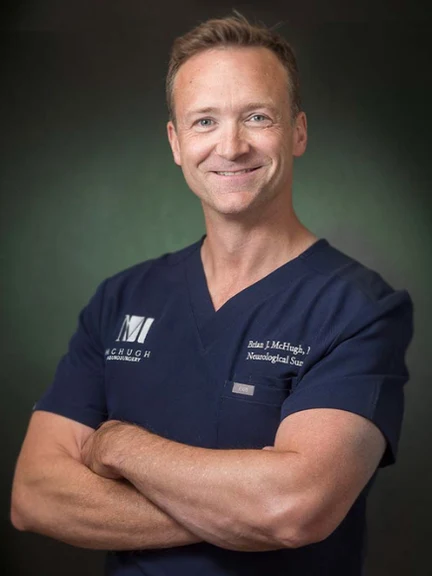
It is a story about what a surgeon chooses to leave alone. Dr. Brian J. McHugh, MD, FAANS, FACS, is a board-certified neurosurgeon whose practice is built on minimally invasive spine surgery, complex spinal reconstruction, and scoliosis care. Fellowship-trained at Yale and the Hospital for Special Surgery, his focus is on motion-preserving techniques and advanced deformity correction.
What “motion-preserving” is actually about
A spine is a chain of moving parts. Historically, the reliable way to stop a painful segment from hurting was to stop it from moving, and fusion remains an essential and sometimes unavoidable operation.
But every segment held still asks the segments above and below it to do more. Motion-preserving technique is the attempt to solve the original problem while leaving the chain as intact as possible, so that the spine a patient has in fifteen years is still a spine that moves.
That framing changes what a surgical conversation looks like. The question stops being simply whether an operation will relieve today’s pain, and becomes what this patient’s spine will be asked to do for the rest of their life.
Three areas of focus
Dr. McHugh’s clinical work covers:
- Minimally invasive spine surgery, reaching the problem with the least disruption to healthy tissue around it.
- Complex spinal reconstruction, for the cases where the architecture itself has to be rebuilt.
- Scoliosis care, including advanced deformity correction.
The common thread is that all three are highly individual. The description he gives of his own approach is personalized, evidence-based treatment for patients with spinal disorders, and the two halves of that phrase are doing equal work. Evidence sets the boundaries of what is reasonable. Which reasonable option is right for a given person is a separate decision, and it is not one a scan makes on its own.
Scoliosis, and why it belongs on this stage
Scoliosis is a useful test of whether an interdisciplinary panel is more than a nice idea. It is a condition that can involve pediatric monitoring, bracing, physical therapy, pain management, imaging, and, for some patients, surgery. Very few of those clinicians share a chart, let alone a room.
It is also the reason the evening has the beneficiary it does. All ticket proceeds from the symposium go to the Curvy Girls Scoliosis Foundation, a peer-support organization for girls living with scoliosis. Having a scoliosis surgeon on the panel and a scoliosis support organization as the beneficiary is not a coincidence, and it makes the connection between the clinical conversation and the people it is about hard to lose track of.
The end of the chain, and the argument for looking upstream
A neurosurgeon usually meets a patient late. By the time someone reaches that office, they have often been through primary care, imaging, injections, and physical therapy, and each of those clinicians made decisions with only part of the picture.
That is exactly what makes the seat valuable in a room like this one. A surgeon sees the outcomes of every earlier decision in the chain, including the ones that worked well enough that surgery never became necessary. Sharing a panel with the disciplines that make those earlier calls is a rare chance to compare notes in the same direction.
Connecting the DOTS
Dr. McHugh joins six other clinicians for Connecting the DOTS at The Piermont in Babylon on Thursday, September 10, 2026, from 5:00 PM to 9:00 PM. The panel runs from 7:15 PM to 8:15 PM.